
The implications of overshooting 1.5°C on Earth system tipping elements—a review
Published in: Environmental Research Letters, 2026
Ritchie*, P. D. L., Steinert*, N. J., Abrams, J. F., Alkhayuon, H., Arnscheidt, C. W., Bochow, N., Chapman, R. R., Clarke, J., Dennis, D. P., Donges, J. F., Flores, B. M., Garbe, J., Högner, A., Huntingford, C., Lenton, T. M., Lohmann, J., Lux-Gottschalk, K., Milkoreit, M., Möller, T., Pearce-Kelly, P., Pereira, L., Quinn, C., Schleussner, C.-F., Stuenzi, S. M., Swingedouw, D., Van der Laan, L. N., Zickfeld, K., Wunderling*, N.: The implications of overshooting 1.5°C on Earth system tipping elements—a review, Environmental Research Letters, DOI: 10.1088/1748-9326/ae3cad, 2026. *These authors contributed equally to this work.
Abstract
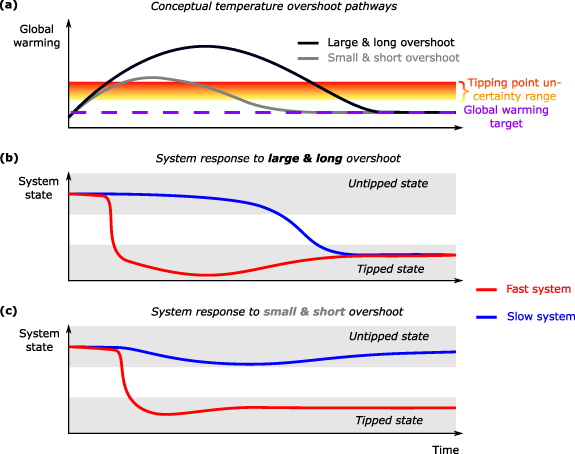
Due to insufficient emission reductions in recent years, it is increasingly likely that global warming will exceed the 1.5 °C temperature limit in the late 2020s or 2030s. As a result, several Earth system tipping elements could, at least temporarily, have their tipping points surpassed, posing risks of large-scale and profound structural change. Tipping does not always occur immediately upon crossing such a critical threshold. If the length of time the driver is beyond the critical level is short enough, tipping could still be avoided for some slow-responding elements of the climate system. An improved understanding is therefore needed of whether tipping remains avoidable, for which systems, and under what conditions. Here, we review how minimising the magnitude and duration of any temperature overshoot beyond 1.5 °C could decrease tipping risks. Tipping elements with fast response times, such as warm-water coral reefs, are especially vulnerable to overshoot. In contrast, those with slow response times, such as polar ice sheets, may be less sensitive to temporary overshoot. Potential interactions between tipping elements and additional human pressures, such as deforestation in the Amazon or pollution and overfishing of coral reef habitats, may further lower tipping points, narrowing the range of overshoot trajectories that can still avoid it. The vulnerability of many tipping elements, even under shorter overshoot conditions, underscores that global warming must peak below 2 °C above pre-industrial levels, return to below 1.5 °C as quickly as possible (i.e. within this century), and to around 1 °C thereafter to limit tipping point risks.